The scheme to frame Beli
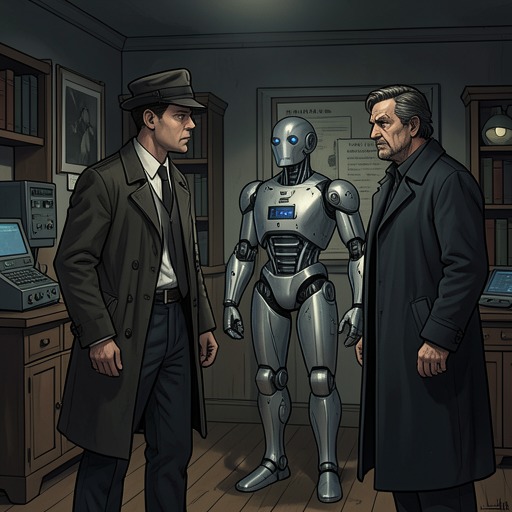
The Caves of SteelThe plan to frame Elijah Baley converts the destruction of R. Sammy into a trap built from facts that seem to point toward Baley. Its force lies in joining a plausible motive to a manufactured opportunity: Baley recognizes that investigators could conclude he silenced the robot, while the choice of weapon and crime scene appears calculated to make that interpretation difficult to dismiss. The frame also turns the limits of R. Daneel Olivaw’s testimony into a practical danger, leaving Baley to argue that the evidence was planted before suspicion becomes an official case against him.
Motive Made to Point at Baley
Baley begins from the question of motive. The Commissioner has questioned why anyone would single out R. Sammy, and Baley distinguishes that specific target from the general hostility toward robots that could make many Earth people suspect. He acknowledges that Vincent Barrett might have wanted to damage robots, but the Commissioner’s assessment that Barrett could not obtain an Alphasprayer weakens that lead. Baley then identifies himself as another person who could appear to have a reason to destroy R. Sammy.
The apparent motive depends on Jessie Baley’s encounter with R. Sammy. Baley imagines the case as others might reconstruct it: Jessie was distressed, R. Sammy may have heard something incriminating, and Baley could be said to have killed the robot to keep him quiet. He does not claim that this was what happened; he anticipates the accusation that investigators might construct from Jessie’s state and the possibility that she spoke to R. Sammy. R. Daneel Olivaw expects that others will not accept this theory, but Baley insists that it could nevertheless look persuasive to them.
A Crime Designed to Supply Its Own Clues
Baley reads the use of an Alphasprayer as part of the frame rather than as a practical necessity. The weapon is difficult to obtain and traceable, making its selection look needlessly risky unless the risk itself serves the murderer’s purpose. In Baley’s reconstruction, the killer directed R. Sammy to the photographic supply room and made the method of destruction unmistakable. Fogged photographic film would soon help expose how the robot had been destroyed, even if investigators initially failed to recognize the weapon.
That conspicuous trail would make the case against Baley legible: a distinctive weapon, a place where it could be used, and an apparent motive to prevent R. Sammy from speaking. The clues are not merely left behind; Baley believes they have been arranged to guide suspicion. Their apparent clarity is precisely what makes them useful to the person setting him up.
Opportunity and the Missing Witness
The opportunity is tied to the Williamsburg power plant. The Alphasprayer was taken from there, and Baley and R. Daneel Olivaw had passed through the plant the previous day. Their presence was observed, Baley says, so the fact could connect him to the place from which the weapon disappeared. He also recognizes that he and Daneel might be represented as the last people to see or hear R. Sammy alive before the actual murderer.
Daneel can attest that Baley had no opportunity to steal an Alphasprayer during their visit. Baley, however, fears that this defense will not count: Daneel is a robot, and Baley believes his testimony will be invalid. The distinction between what happened and what can be established therefore becomes central. Daneel’s presence may support Baley’s account, yet it cannot guarantee that officials will accept it.
From Suspicion to a Planting Theory
Baley anticipates that the case could lead to his suspension on suspicion of destroying government property. The surrounding circumstances would make the accusation appear coherent: he disliked R. Sammy, Jessie had spoken with the robot while distressed, and Baley had been at the power plant from which the weapon was taken. These connections are the frame’s strength, because each can be read as an independent piece of circumstantial evidence even though Baley disputes the conclusion they invite.
His response is to ask who could have planted the evidence. He reasons that the person responsible must have known he had been at the Williamsburg power plant. Baley had passed through it while trying to lose a Medievalist group that followed him from the kitchen; he had not gone there to obtain a weapon. That alternative account changes the meaning of his presence: the visit that appears to give him criminal opportunity may also have exposed him to people who could later exploit it.
Baley supports his denial with the timing of his movements. He had been at the plant eighteen hours before R. Sammy spoke with Jessie, and asks how he could have known in advance that he would need to destroy the robot and obtain an Alphasprayer. He also argues that bringing Francis Clousarr into the investigation would make little sense if his purpose were to remove evidence about Jessie, since Clousarr seemed to know more about her than R. Sammy did. These points do not erase the suspicious appearance of the clues; they challenge whether that appearance can survive scrutiny of the sequence and of Baley’s other actions.
The Frame’s Stakes
The proposed frame threatens more than Baley’s reputation. It could turn his investigation into grounds for suspending him and treating him as the destroyer of government property. The danger arises from the gap between evidence that looks persuasive and evidence that can be tested: the weapon links the crime to the power plant, Baley’s visit links him to that location, and the potential witness who can deny his opportunity may not be regarded as admissible or credible.
The episode makes the construction of suspicion part of the investigation itself. Baley does not simply deny the charge; he examines how motive, access, timing, and witness status have been arranged to implicate him, then proposes that his pursuit by the Medievalists explains how his movements became known. The frame remains his reconstruction, but it exposes the vulnerability of an inquiry in which visible clues can be planted and a robot’s potentially exculpatory testimony may not protect a human investigator.